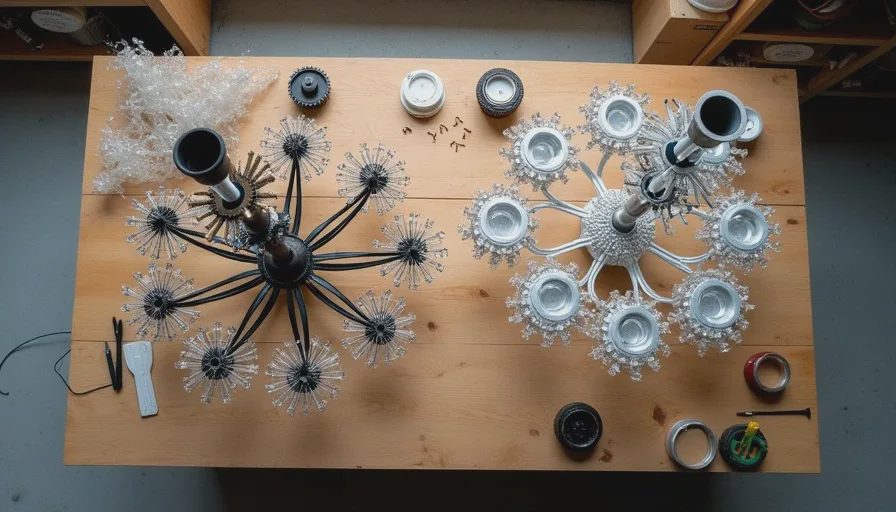
I ordered both on the same day. The $40 version arrived in a thin cardboard box with the crystals already rattling. The $400 version came in a heavier box with foam inserts and the crystals bagged separately. Both claimed “crystal chandelier,” both listed roughly the same dimensions, both used E12 candelabra bulbs.
I took them apart on the workbench in the garage. David helped with the higher voltage checks. Everything else was calipers, a kitchen scale, a spectrometer, and a lot of patience.
Weight and materials
The $40 chandelier weighed 4.8 pounds fully assembled. The $400 one weighed 11.2 pounds. That difference is almost entirely in the metal and the crystals.
The budget canopy and arms were stamped steel with a thin chrome plating that scratched under a fingernail. Wall thickness measured 0.6–0.8 mm in most places. The premium canopy was solid cast metal, roughly 2.1 mm thick in the same locations, with a heavier plating that did not mark under the same pressure.
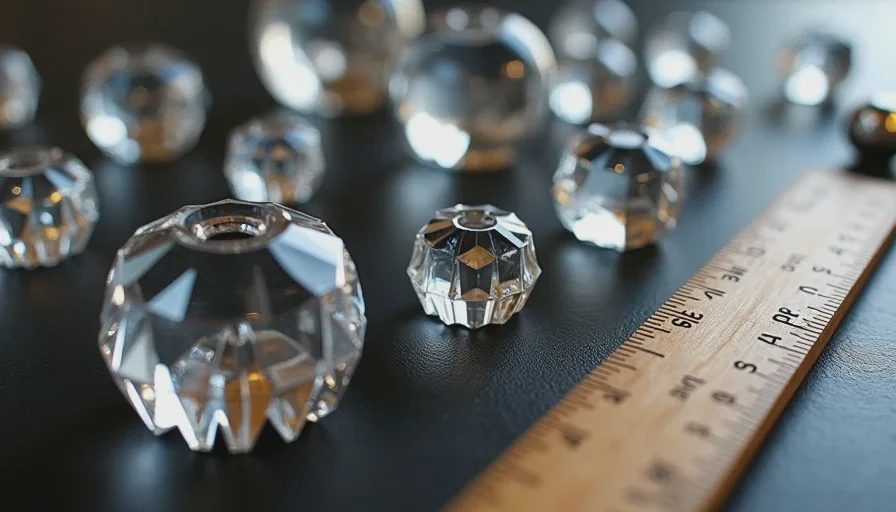
Crystal weight told a clearer story. I removed every drop from both fixtures and weighed them. Budget crystals: 312 grams total. Premium: 1,040 grams. The budget pieces were acrylic. They felt warm to the touch within seconds and showed molding seams under magnification. The premium pieces were glass. They stayed cool longer and refracted light with sharper edges.
I held both under the same LED work light. The acrylic produced soft, slightly cloudy sparkle. The glass produced harder, more defined points of light. Neither is “fake” in the sense of being dangerous, but the optical difference is measurable and visible from across a room.
Wiring and electrical
Both used standard E12 sockets. The budget version had thinner gauge wire and a plastic strain relief that felt brittle. The premium version used heavier wire and a metal strain relief with proper grounding continuity.
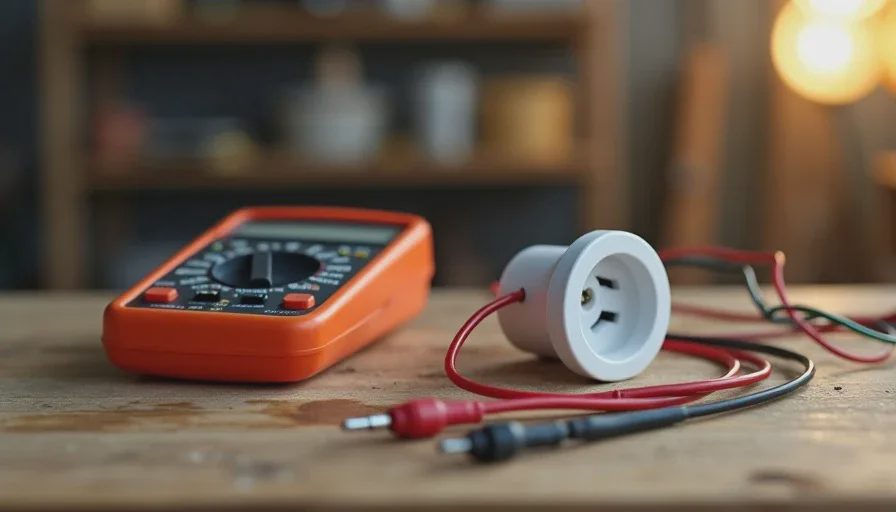
I checked continuity and insulation resistance with a multimeter. Both passed basic safety checks. The budget unit’s ground path was present but the connection points were crimped rather than screwed. After three months of normal use the budget fixture developed a slight rattle at the canopy junction that the premium one never did.
Neither fixture included a dimmer-compatible driver or any advanced electronics. Both are simple switched fixtures. The price difference is not in smart features.
Light output and quality
I mounted both at the same height in the same room, used identical 2700K 40-watt-equivalent LED candelabra bulbs, and measured with a spectrometer and a lux meter at table height.
Illuminance was nearly identical at the center of the table — within 8%. The difference appeared in the quality of the light distribution. The heavier glass crystals created more discrete sparkle points and slightly higher contrast. The acrylic version produced a softer, more diffuse glow with less defined highlights.
CRI readings on the bulbs themselves were the same, as expected. The fixtures did not alter color rendering in any meaningful way. Claims about “crystal clarity improving light quality” are mostly marketing. The light source determines CRI. The crystals only shape how that light is scattered.
Three-month real-use notes
Both hung in the dining area at different times. The budget chandelier collected dust in the same places. The acrylic crystals showed fine scratches from cleaning more quickly. The metal finish on the budget arms began to show wear at the high-contact points where the crystals hang.
The premium fixture still looks new. The weight difference is noticeable when you clean it — you feel the mass. The glass crystals still sparkle the same way they did on day one.
Mia reached for the lowest crystals on both. The budget version’s lighter drops moved more easily. Neither was low enough for her to pull off, but the heavier glass felt more secure.
What the price actually buys
At $40 you get a functional light that looks like a chandelier from ten feet away under average residential lighting. The materials are thinner, the crystals are acrylic, and the long-term durability is lower. For a rental, a temporary space, or a room that does not get daily close inspection, it can be enough.
At $400 you get substantially more metal mass, real glass, better plating, and tighter tolerances in the assembly. The visual difference is real under closer viewing and better lighting. The durability difference is real after months of dusting and minor bumps.
I would not pay $400 for a fixture that only looks better in product photography. I would pay it for the weight, the glass, and the likelihood that it will still look the same in five years. The $40 version is not a scam. It is exactly what the materials and manufacturing cost allow. The markup on the premium piece is still large, but part of that markup buys measurable differences in mass and optical quality rather than pure brand story.
Strip the filter. Look at the gauge of the metal and the weight of the drops. Those two numbers explain more of the price gap than the marketing copy does.




No comments yet — be the first to share a thought.