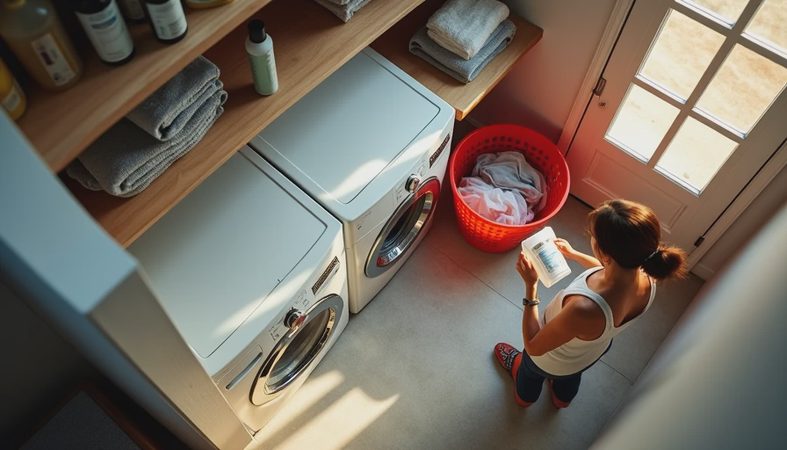
Small laundry room storage ideas have to solve more than a square-footage problem. They need to handle detergent bottles, damp clothes, lint, cleaning tools, and the occasional toddler determined to open every cabinet. I tested the layout in our 1998 Austin renovation by measuring clearances, loading shelves with real supplies, and watching what Mia could reach. The winning approach was not a glossy wall of matching bins. It was shallow storage, closed lower cabinets, and one useful surface for folding.
A compact laundry room usually fails when everything is pushed upward. High shelves look tidy in photographs, but they turn daily tasks into a balancing act with a heavy detergent jug in one hand. Start by listing what actually lives there: detergent, stain remover, dryer sheets, a laundry basket, an iron, a vacuum attachment, and spare towels. Measure each item before buying organizers. A 12-inch cabinet that cannot close around your detergent is decoration, not storage.
Measure the room before buying anything
The first of my small laundry room storage ideas is boring and nonnegotiable: measure the usable wall, not the room shown on the floor plan. Record the width between the appliances, the door swing, baseboard height, outlet locations, water valves, and the depth of the washer and dryer. Leave enough clearance for hoses and ventilation. A shelf that projects 16 inches into a narrow walkway can make the door hit it or force you to stand sideways while loading the machine.
For many compact rooms, 10 to 12 inches of shelf depth is enough for folded towels and standard cleaning bottles. Deeper shelves encourage a second row of forgotten products. I prefer adjustable shelves with a front lip or cabinet doors, especially below shoulder height. If you install a shelf over a front-loading pair, keep the lower edge high enough that the washer lid, detergent drawer, and service access remain usable. David and I mark the wall with painter's tape for a week before drilling. That cheap test catches surprisingly expensive mistakes.

Use vertical space without creating a climbing hazard
Tall storage is valuable, but stability matters more than capacity. A narrow tower cabinet can hold baskets and an ironing board, yet it becomes a serious tip risk if a child climbs the shelves. Anchor freestanding furniture to a wall stud with the manufacturer's hardware, and avoid placing a lightweight bookcase beside the machines where vibration can make items migrate.
One practical arrangement uses a 12-inch-deep upper cabinet for backstock, a wall-mounted drying rail, and a closed base cabinet for products used every week. Put bleach, pods, and stain chemicals in a latched cabinet or a cabinet positioned well out of reach. Child-resistant packaging is not childproof, and a clever three-year-old can move a stool faster than an adult expects.
Open wire shelves are inexpensive, but inspect the finish and edges. Mia would drag a basket across them, scrape a finger on a rough weld, and knock a bottle through a wide opening. Look for rounded edges, a stable mounting system, and shelves that do not flex under a 20-pound load. Strip the filter. Look at what's underneath the marketing label.
Build a folding zone, even if it is small
A folding surface is one of the most useful small laundry room storage ideas because it prevents clean clothes from becoming a floor pile. You do not need a full countertop. A 20-inch-deep butcher-block surface over front-load machines can provide enough room for sorting socks and folding shirts. A laminated panel can cost roughly $50 to $150, while custom quartz or solid-surface work can run several hundred dollars before installation.
The material needs to tolerate moisture and repeated wiping. I like sealed hardwood when the edges are properly finished; unfinished wood absorbs drips and develops dark marks around the washer. Laminate is less romantic but often more practical. Avoid a sharp exposed corner at hip height. A rounded edge or a small corner radius matters when a child is running through the room carrying a toy.
If a countertop is impossible, install a wall-mounted drop-leaf table. Check its load rating and attach the brackets to solid framing or properly installed blocking. Test it with a full laundry basket before trusting it. When folded up, it should leave the walkway clear rather than becoming another obstacle.

Choose containers for the way you actually do laundry
Uniform clear bins are popular, but they are not automatically useful. A large opaque tub hides the one product you need, while a tiny decorative box forces constant refilling. For detergent and stain treatments, choose containers with wide openings, secure lids, and labels that remain readable after wet hands touch them. Keep original hazard information available, particularly for concentrated products.
For sorting, two medium hampers are usually easier to manage than one enormous divided hamper. One can hold lights and one darks, or one can be reserved for towels. A slim rolling hamper works when the floor is level and the wheels lock. Measure the handle height against the countertop; a basket that catches on the cabinet every time will eventually be parked in the hallway.
Hooks are excellent for reusable dryer balls, dustpans, and a small mesh bag. They are poor for overloaded wet towels. Use a rail or sturdy wall hooks rated for the weight, and fasten them into a stud whenever possible. These small laundry room storage ideas should reduce motion through the room, not create a maze of hanging objects.
Control moisture, lint, and visual clutter
Laundry rooms are working rooms, so storage materials need to tolerate humidity and lint. MDF shelving with an unsealed edge can swell after one hose leak. Look for sealed edges, powder-coated metal, or plastic that does not become brittle. Keep paper goods and cardboard packaging away from the floor and from the back of the dryer.
Leave space around the dryer vent and service connections. Do not bury the shutoff valves behind permanent cabinetry, and do not block the lint filter or exhaust path with baskets. A pretty cabinet that makes maintenance difficult is a future repair bill. I also keep a small labeled container for loose buttons and a washable microfiber cloth on the folding surface so minor cleanup happens immediately.
Color matching is optional. Function is not. A $70 shelf that stays organized for five years can outperform a $400 custom insert that wastes half its depth. Stop staring at the price tag. Divide it by the years you will use it, then compare that number with the cost of replacing warped or flimsy storage.
A practical layout plan for renters and homeowners
Renters can get much of the benefit with tension-mounted drying rails, rolling carts, over-door hooks, and freestanding cabinets anchored where the lease allows. Measure the cart against the door trim before ordering. A cart that is 6 inches narrower may hold less, but it can preserve access to the water shutoffs and make the room feel dramatically easier to use.
Homeowners have more options: install blocking before drywall, add a shallow upper cabinet, or build a countertop that bridges the machines. Before construction, locate plumbing and wiring rather than assuming the wall is empty. For a small renovation, prioritize one closed cabinet, one folding zone, and one vertical drying solution before spending money on decorative tile or custom labels.
The most durable small laundry room storage ideas are the ones that make the next load obvious. Dirty clothes have a landing spot, detergent is reachable by an adult but not a child, clean items have somewhere to fold, and maintenance access remains clear. Test the room with a full basket, damp towels, and a tired parent. If the layout still works then, it is ready for real life.




No comments yet — be the first to share a thought.