I tested the best artificial christmas trees the way I test everything that enters my house: by looking past the product photography and checking what happens when a real child, a vacuum, and a storage closet get involved. A tree can look lush in a listing and still arrive with sparse branches, a wobbly stand, or a strong plastic smell. The question is not simply whether it photographs well. It is whether it can survive years of setup, decoration, dusting, and one determined toddler trying to pull off the lowest ornament.
My baseline is simple. I want a tree with a stable metal stand, dense branch tips, hinges that do not feel flimsy, and materials that are clearly identified. I also want realistic expectations about assembly. A seven-and-a-half-foot tree with three sections is not difficult, but it is awkward when one person is holding the base while another fluffs branches. David handles the upper section in our house; I handle the measuring tape and the branch inspection.
What separates the best artificial Christmas trees from decorative filler
Start with the branches, not the lights. Artificial trees usually combine molded needles, flat PVC needles, or a mixture of both. Molded PE tips tend to look more natural because they copy the shape of real needles, while PVC creates fullness at a lower price. The strongest-looking trees often use molded tips on the outer branches and PVC material deeper inside, where gaps are less visible.
Look closely at branch construction. A tree with hinged branches is faster to assemble, but each hinge is another moving connection that can bend or loosen. Open the branches before judging fullness. Manufacturers compress them tightly for shipping, and a tree that looks thin straight out of the box may improve dramatically after 30 to 45 minutes of shaping. Still, no amount of fluffing can create missing branch tips. If the center pole is obvious after careful shaping, the savings were not real.
Needle color matters too. One flat, shiny green often looks artificial under warm lamps. Mixed tones, brown interior stems, and varied tip lengths create depth. That does not mean a heavily flocked tree is automatically better. Flocking can shed during setup and may be harder to clean around children, pets, or light-colored flooring.
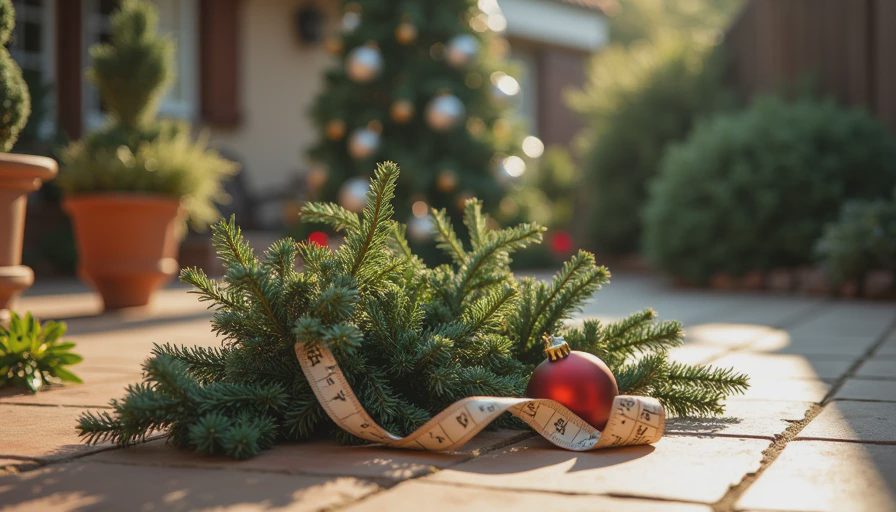
Measure the room before you buy
The best artificial christmas trees are often rejected for a boring reason: they are too tall or too wide for the room. A tree labeled seven and a half feet may need another 10 to 14 inches for a stand topper, star, or angel. Measure from the floor to the lowest ceiling obstruction, including a ceiling fan, and subtract at least 12 inches before choosing a height.
Width can be even more important. A full seven-and-a-half-foot tree may spread 50 to 60 inches at its widest point. In a small living room, that can block a walkway, crowd a sofa, or force furniture into a less safe arrangement. Slim and pencil shapes solve the floor-space problem, but inspect their lower branches carefully. Some narrow trees look acceptable from the front and nearly bare from the side.
I use painter's tape to mark the intended footprint before ordering. This takes two minutes and prevents a surprisingly expensive return. Also check the packed dimensions and box weight. A 70-pound carton is manageable on a delivery pallet but unpleasant on a staircase. If storage is upstairs or in a detached garage, a lighter tree in smaller sections may be worth more than extra realism.
Safety starts with the stand and wiring
When Mia touches, licks, or bumps into something, I stop caring about the catalog styling and start checking failure points. The stand should open wide enough to resist tipping, and its screws should tighten smoothly without stripping. Avoid placing the tree where a child can use a nearby chair, ottoman, or low shelf as a launch step. A stable base helps, but placement still matters.
For a pre-lit tree, inspect the cord, plug, socket connections, and label before decorating. Look for clear instructions about replacement bulbs, electrical ratings, and whether the lights are intended for indoor use. Do not connect more light strings than the manufacturer permits. LED lights generally produce less heat than traditional incandescent bulbs, but that does not make damaged wiring safe.
A flame-resistant label is useful, but it does not make a tree fireproof. Keep it away from fireplaces, radiators, heat registers, candles, and overloaded outlets. I also prefer a tree with accessible plugs and sections that can be tested separately. Finding one dead light strand before the ornaments are on is a five-minute fix; finding it on Christmas Eve is a full mood collapse.
Pre-lit or unlit: choose based on repair tolerance
Pre-lit trees save setup time and reduce the yearly tangle of light strings. That convenience is real, particularly for a family that wants to decorate after bedtime. The tradeoff is repair complexity. If a section fails, you may need to trace connectors or replace a fuse. Some designs allow replacement bulbs and spare parts; others rely on integrated light strips that are less convenient to service.
Unlit trees take longer to decorate but give you control over color temperature, wire placement, and replacement cost. A basic set of indoor LED lights can cost roughly $25 to $80 depending on length and quality. It is easier to replace one string than to replace an entire pre-lit tree because a section stopped working.
For our house, I would choose pre-lit for a frequently used family room and unlit for a long-term investment tree. Either choice can be sensible, but read the warranty language before assuming lighting is covered. The best artificial christmas trees are not automatically the most convenient ones; they are the ones whose maintenance matches your patience.

What good value actually looks like
Price alone tells you almost nothing. A $150 tree may serve well for several seasons if it has a decent frame, while a $600 tree can disappoint if the branch tips are sparse or the lights are difficult to repair. Instead, divide the cost by the years you realistically expect to use it. A $360 tree used for 10 years costs $36 per year before replacement lights. That is easier to defend than buying a $180 tree twice after two disappointing seasons.
Retail timing affects prices. Artificial trees commonly receive discounts after Thanksgiving and near the end of December, but popular heights and colors can sell through first. Compare the full delivered price, return shipping rules, warranty length, replacement-part availability, and storage requirements. A dramatic sale is not a bargain if returning a heavy carton costs $100.
Brand names can help with parts and customer service, but they are not a substitute for inspection. National retailers, specialty holiday companies, and warehouse stores all sell mixed-quality models. Strip the filter. Look underneath the marketing label at branch material, stand width, packed weight, lighting design, and the actual warranty.
My buying checklist for a family home
Before clicking purchase, confirm the ceiling height, maximum tree width, section count, assembled weight, and packed box dimensions. Read reviews specifically for missing parts, bent hinges, light failures, strong odors, and stand damage rather than relying on star ratings. Check whether the seller provides a return window long enough to assemble and inspect the tree.
When it arrives, photograph the box before opening. Assemble the base on a clear floor, check every connection, and leave the tree un-decorated overnight if you notice a strong odor. Fluff it in good light, rotate it, and inspect it from the sofa, doorway, and side angle. That is how you find the bald patch that product photos never show.
The best artificial christmas trees should make December easier, not create a yearly repair project. My final Mia test is blunt: can the base stay steady, are the lower branches free of sharp exposed wire, and can the cord be kept out of reach? If the answer is yes, the tree has earned its place in the living room. If not, no amount of glitter will rescue it.


No comments yet — be the first to share a thought.