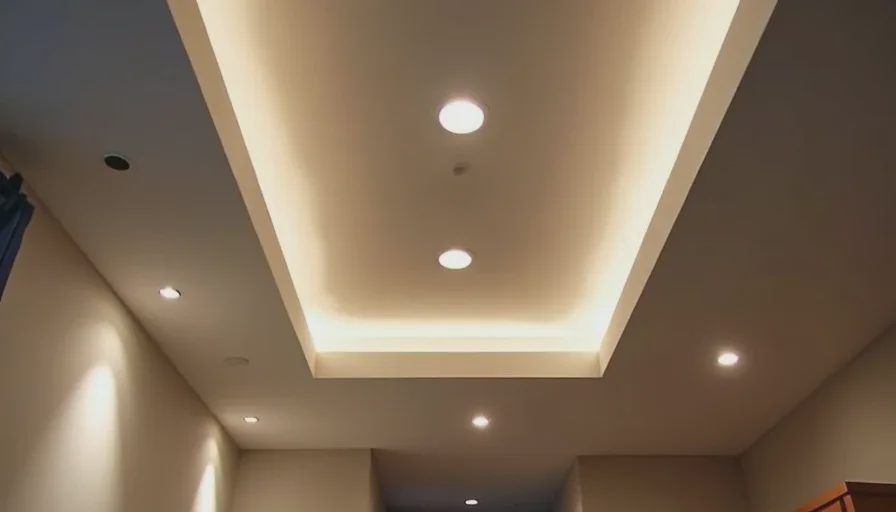
Babies spend a lot of time on their backs. Crib, floor, changing table—any of those positions puts the ceiling lights directly in their line of sight. Standard recessed downlights and especially flush wafer lights put a bright source right in that view. Mia would squint, turn her head, or get fussy under certain fixtures even when the overall room light level was comfortable for adults standing up.
I tested the difference between deep-baffle (or deep-regress) downlights and more common standard or wafer-style recessed fixtures in the same rooms. The metric was simple: could a child lying on the floor look toward the ceiling without obvious discomfort, and did the adult experience of the room stay pleasant at the same time.
What creates the glare
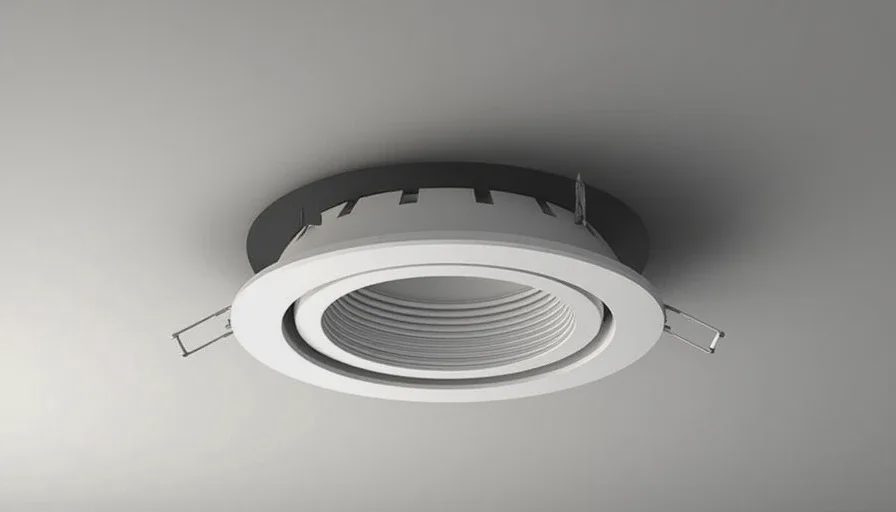
Glare here is discomfort glare—the kind that makes you want to look away even if you can still see. It comes from high luminance in the field of view. When the LED module or the bright reflector sits near the ceiling plane, anyone looking upward sees that high-luminance surface directly. The effect is worse with higher output fixtures and with cooler color temperatures, but even 2700K sources can produce it if the optics are shallow.
Deep-baffle and deep-regress designs set the light source back into the ceiling cavity, typically 2 to 3 inches or more. The baffle walls or the regress depth create a shielding angle. From normal viewing positions—including the floor—the bright source is hidden behind the rim. You see the illuminated room, not the lamp itself. Black or dark baffles absorb stray light; white baffles reflect more of it downward but still benefit from the depth.
Standard trims and wafer lights keep the source close to or flush with the ceiling. They are thinner, cheaper, and easier to install in shallow joist spaces. They also place the bright aperture in plain sight whenever someone looks up.
The floor-level test
I installed or temporarily mounted comparable lumen packages in both styles in the living room and in Mia’s room. Color temperature stayed in the 2700–3000K range we already prefer for evening spaces. I lay on the floor in the positions she uses and also watched her reactions during normal play.
Under the standard and wafer fixtures the bright circles were immediately noticeable. Prolonged looking produced the same squint and head-turn I had seen before. Under the deep-baffle units the ceiling appeared much quieter. The light was present in the room—surfaces were lit, shadows were soft—but the source itself stayed hidden. Mia did not show the same avoidance behavior. Adults standing or sitting also reported less awareness of the fixtures; the ceiling simply looked calmer.
I checked basic luminance impressions with a meter where I could, but the behavioral response was the more useful data. A fixture can meet a laboratory UGR target and still feel wrong in a specific room geometry. Watching a child who has no social reason to tolerate discomfort is a direct readout.
Other performance differences
Deep-baffle fixtures often use more controlled optics and can deliver better beam definition. That helps with even ambient coverage when the layout is planned correctly. They also tend to cost more and require more ceiling depth or a dedicated housing. In a 1998 house with mixed framing we had to verify clearances before committing to full runs.
Wafer and ultra-thin fixtures win on installation ease and on very shallow cavities. They lose on visual comfort the moment anyone spends time looking upward. In hallways or pure task zones that may be acceptable. In bedrooms, nurseries, and living rooms where people recline or children play on the floor, the comfort penalty is real.
Light output and efficiency can be comparable between well-designed examples of both types. The difference is not primarily lumens per watt. It is where those lumens originate relative to the eye.
What we standardized on
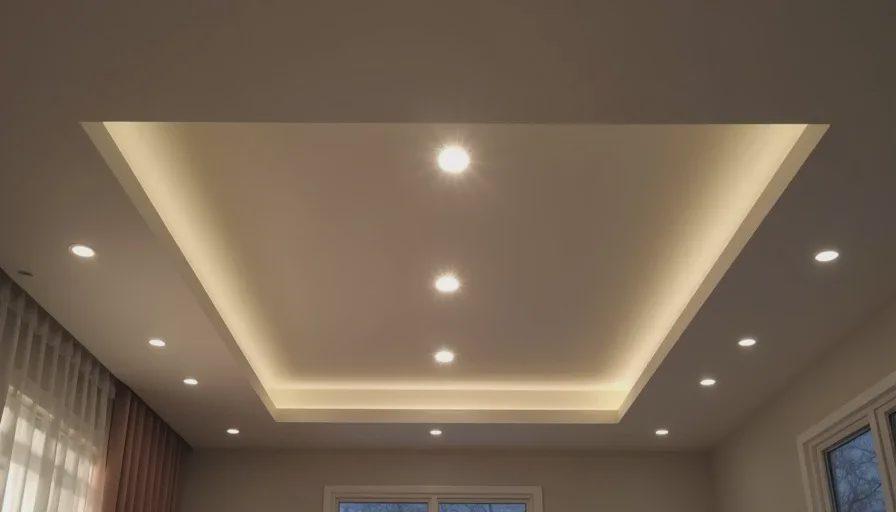
For Mia’s room and the main living areas we specified deep-baffle or deep-regress downlights with dark or matte baffles, 2700–3000K, high CRI, and dimming that stays stable at low levels. The goal was a ceiling that stays visually quiet even when the lights are on. Accent and decorative fixtures can still provide interest; the general ambient layer does not need to announce itself with glare.
In secondary spaces or where depth was truly limited we accepted shallower fixtures but kept output modest and relied more on wall wash or indirect light to reduce the need for high-intensity recessed points.
Practical selection notes
Look at the fixture from a low angle before you buy a full set. If you can see the LED or a bright reflector face while standing a few feet away and looking up, the same view will be worse from the floor. Check the published shielding angle or regress depth if the manufacturer provides it. Prefer baffles over open reflectors when glare control is the priority. Confirm dimming performance; a fixture that flickers or shifts color at low levels undermines the comfort benefit.
UGR numbers below 19 are a useful target for residential comfort, but they are calculated for specific room conditions and observer positions. Treat them as a filter, not a guarantee. Real observation in the actual space still matters.
A baby on the floor is an unforgiving critic of ceiling lights. If the fixture makes her look away, it will eventually make everyone else notice the glare too. Deep baffles do not solve every lighting problem, but they solve the specific problem of a bright source staring back at anyone who looks up. In a house with a young child that is one of the more important details on the ceiling plan.



No comments yet — be the first to share a thought.