A Small Laundry Room does not need to feel like a punishment box behind the kitchen. I know because I have spent months testing storage, flooring, lighting, and hardware in my own 1998 Austin fixer-upper, with Mia pushing toy cars through the doorway while I measured clearances. The pretty online photos are the easy part. The harder questions are whether a child can pull down a detergent bottle, whether a cabinet survives humidity, and whether you can remove the washer filter without dismantling the room.
My rule is simple: strip the filter and look at what is underneath. Before buying a $2,000 cabinet system, measure the machines, door swing, water hookups, drain location, baseboard, and the path used to carry a full basket. A good plan saves more money than a decorative shelf ever will.
How to Plan a Small Laundry Room Before Buying Anything
Start with a scaled drawing, even if it is only on graph paper. Record the width, depth, and height at several points because older homes rarely have perfectly square walls. A room that measures 62 inches at the floor but 60 inches at countertop height cannot accept every standard cabinet combination.
For side-by-side machines, leave enough working space to open both doors and reach the shutoff valves. Front-load washers generally need room in front for the door and gasket, while top-load washers require unobstructed lid clearance. Do not push machines tight against drywall just to gain two extra inches of shelf space. Hoses bend, vibration happens, and a service technician needs access.
If you are choosing between a stacked unit and separate machines, compare more than floor area. Stacking can free a useful 30-inch-wide zone for a folding counter or tall hamper. Separate machines offer a broader folding surface but often create an awkward gap that collects lint. A sturdy washer pan with a drain connection is sensible on an upper floor, although it does not replace checking hoses and fittings.
Make a Small Laundry Room Safer for Children and Easier to Maintain
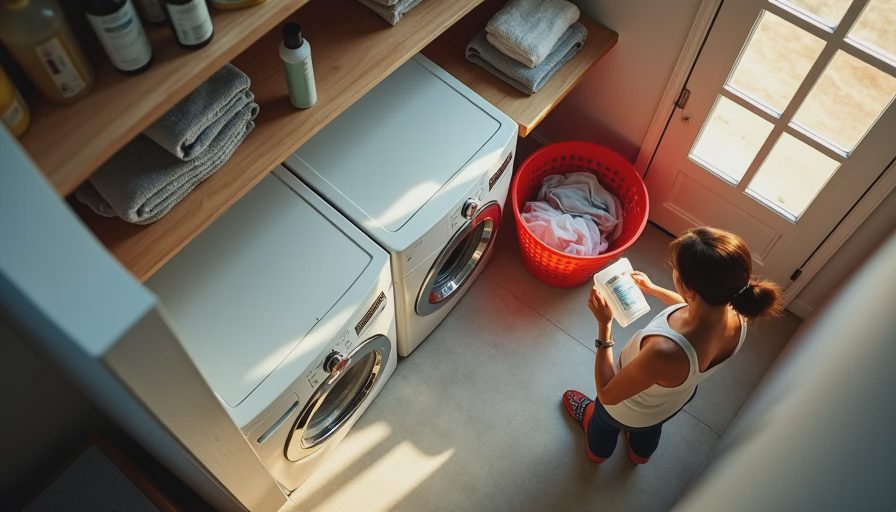
The Mia test starts at hand height. Laundry pods, bleach, stain remover, and dryer sheets should never live in an unlocked low drawer. Use a wall cabinet with a reliable latch, or keep chemicals in a locked area outside the room. A toddler will treat a rolling hamper as climbing equipment, so choose a stable model and avoid placing it beneath a window or shelf that can be pulled down.
A Small Laundry Room also needs moisture control. Run the exhaust fan during washing and for several minutes afterward if the room has one, and leave the washer door open between cycles if the manufacturer allows it. Wipe the gasket regularly, especially around the bottom fold where hair and residue collect. I prefer washable satin-finish paint over porous wallpaper because splashes can be cleaned without turning a small mark into a renovation project.
For floors, porcelain tile is practical because it handles water and does not swell like many floating wood products. Choose a surface with enough texture to resist a wet sock underfoot, but not such a deep pattern that lint hides in every groove. A small silicone mat in front of the machines helps with drips, but it should have a flat, noncurling edge. That edge matters when Mia is running in with a basket.
Storage That Earns Its Square Footage
In a Small Laundry Room, storage should be assigned to a job before it is purchased. A 12-inch-deep cabinet can hold detergent, brushes, and folded towels without swallowing walking space. A shelf above the machines is useful for lightweight supplies, but it needs a lip or containers that will not slide during spin cycles.
I like a counter over front-load machines when the installation allows it. A 25- to 30-inch-deep worktop creates a place to fold clothes and prevents socks from disappearing behind the washer. Moisture-resistant laminate is usually more forgiving than unfinished wood, and a solid-surface remnant can be excellent if the price is reasonable. Quartz is durable, but spending $800 on a countertop does not fix poor ventilation or an unreachable drain.
Add one narrow pullout for a broom, ironing board, or drying rack if the layout permits. Hooks are useful for mesh bags and air-dry garments, but mount them where they cannot become a forehead hazard. Deep baskets are less efficient than labeled bins because small items migrate to the bottom. I test every bin with one hand while holding a laundry basket in the other; if the lid requires two hands, it will eventually be left open.
Lighting and Materials That Do Not Fake Quality
A Small Laundry Room needs bright, even light rather than one decorative pendant casting a shadow behind the washer. A flush LED fixture with a color temperature around 3000K to 4000K makes it easier to spot stains and read care labels. Put a switch near the entrance, not behind an open door. Under-cabinet lighting is helpful over a folding counter, provided cords and adapters stay away from wet areas.
Look closely at cabinet construction. Thermofoil can be easy to wipe, but damaged edges may peel when exposed to heat and moisture. Painted plywood or well-sealed MDF can perform better when edges are finished properly. Open shelving is cheaper and visually lighter, yet it displays every bottle and encourages clutter. If you use it, transfer supplies into matching, clearly labeled containers and keep original warnings available.
Hardware deserves the same scrutiny. A smooth pull with rounded ends is less likely to catch clothing or bump a child than a sharp bar. Test the hinges and drawer slides with actual weight, not an empty showroom sample. This is where my furniture-sourcing background helps: a thick-looking front tells you almost nothing about what is behind it.

What a Realistic Budget Looks Like
A cosmetic refresh for a Small Laundry Room can cost roughly $300 to $900 for paint, lighting, shelves, bins, and a new mat. Replacing flooring and adding a basic counter can move the project into the $1,500 to $3,500 range. Cabinetry, electrical work, plumbing changes, and new appliances push the budget much higher. The expensive mistake is usually not the tile; it is ordering storage before confirming machine dimensions.
Spend first on leak prevention, ventilation, safe electrical work, and access for repairs. Spend second on surfaces that tolerate water and detergent. Spend last on decorative signs, expensive baskets, and hardware that only looks good in a photograph. A $40 washable bin that survives three years beats a $140 woven basket that develops mildew after one season.
Think in cost per year. If a $700 counter lasts ten years and makes every load easier, that is $70 per year before considering resale value or reduced replacement waste. Stop staring at the price tag. Divide it by the years you will use it, then compare that number with the cost of fixing swollen cabinets or a cracked floor.
My Practical Small Laundry Room Checklist
Before ordering, measure the machines with hoses and doors included. Confirm the location of shutoff valves, the drain standpipe, vent route, electrical receptacle, and gas connection if applicable. Photograph the wall before closing it so you know where studs and pipes sit. Mark the cabinet depth on the floor with painter's tape and walk through with a full basket.
Then check the details people skip: Can you remove the lint filter? Can you reach the washer drain pump? Does the cabinet door hit the machine? Is the exhaust fan loud enough that nobody uses it? Can a child reach detergent from the hamper or counter? If the answer to any of these is yes, revise the plan before delivery day.
The best Small Laundry Room is not the one with the most shelves or the most expensive tile. It is the one that contains water, hides hazards, provides a stable folding surface, and still works when laundry is piled everywhere. What Mia would do to it is the final test: if she can climb it, lick it, pull it, or bump into it, I redesign it until the risk is boring.




No comments yet — be the first to share a thought.